
Japan Car Auction Grades
The auction grading system in Japan is very good, probably the best that is possible. There are some slight differences between the auction house groups, and they do update the wording of criteria from time to time; however, the table below contains the main points and is also based on our experience at inspecting cars.
Auction Grades
| Grade | Condition | Description |
|---|---|---|
| S | New | No damage, no repair, no modification. |
| 6 | Almost New | No damage, no repair, no modification. Less than 36 months old from first registration date and travelled less than 30,000 km. |
| 5 | Immaculate | No replacement of any panels. The exterior may have some very minor scratches and marks (very hard to see any). The vehicle has travelled less than 50,000 km. |
| 4.5 | Very Good | The exterior generally has more minor scratches and marks than grade 5 (still very few). May have a replacement of a panel that is fixed by screws (e.g. doors, fenders). The vehicle has travelled less than 100,000 km. In our experience, these are some of the best quality used cars, usually requiring no work. |
| 4 | Good | The exterior has some scratches or scrapes and possibly minor dents. The vehicle has travelled less than 150,000 km. May have had panel replacement, but none replaced that require welding (e.g. rear quarters, door sills). In our experience, this grade is a good quality used car but sometimes needs minor bodywork or paint to be perfect. |
| 3.5 | Average | The exterior usually has some more noticeable scratches, scrapes or dents. May have had panel replacement that required re-welding (e.g. rear quarters, door sills). In our experience, this grade usually has some scratches or dents (bumpers, plastic parts, wheel arches). |
| 3 | Low Condition | May have a panel replacement or modification that required welding of the structure (e.g. rear quarters, door sills). The exterior may have more noticeable large scratches, scrapes, paint blemishes or larger dents. It may also be a modified car (race car) or a repaired car. |
| 2 | Very Low | Very poor condition. It may have large corrosion holes or significant structural issues. |
| 1 | Major Issue | Flood or Fire Damaged Cars. |
| R | Repaired | Has had some repair to the structural parts in the table below. In our experience, the repair quality varies and we would suggest having an inspection. Sometimes they can be good, and sometimes they are not so good. |
| RA | Minor Repair | Cars that have had minor repairs to structural components, or, they are well repaired. In our experience, these cars can look as good as a grade 4 or above. |
| *** | Recycle Cars | Cars that have been entered into the 'recycled auction section'. Usually damaged cars, but sometimes they are running with engine or transmission issues. Non-running cars are moved by forklifts and require special transport procedures which are more costly. These cars are not graded by the auction house. |
Interior Grades
| Grade | Description |
|---|---|
| A | The interior condition is excellent, maybe a few minor scratches. |
| B | The interior condition is very good, maybe some minor wear or scratches. |
| C | The interior is worn, maybe average condition for the age. Possibly some stains, scratching, loose upholstery, more scratches or some burns. |
| D | The interior is very worn. Possibly heavy stains, loose upholstery, dashboard cracking, seats torn, burn holes in seats. |
| E | The interior is in very poor condition and will need extensive repair or replacement of parts. |
How to Read an Auction Sheet
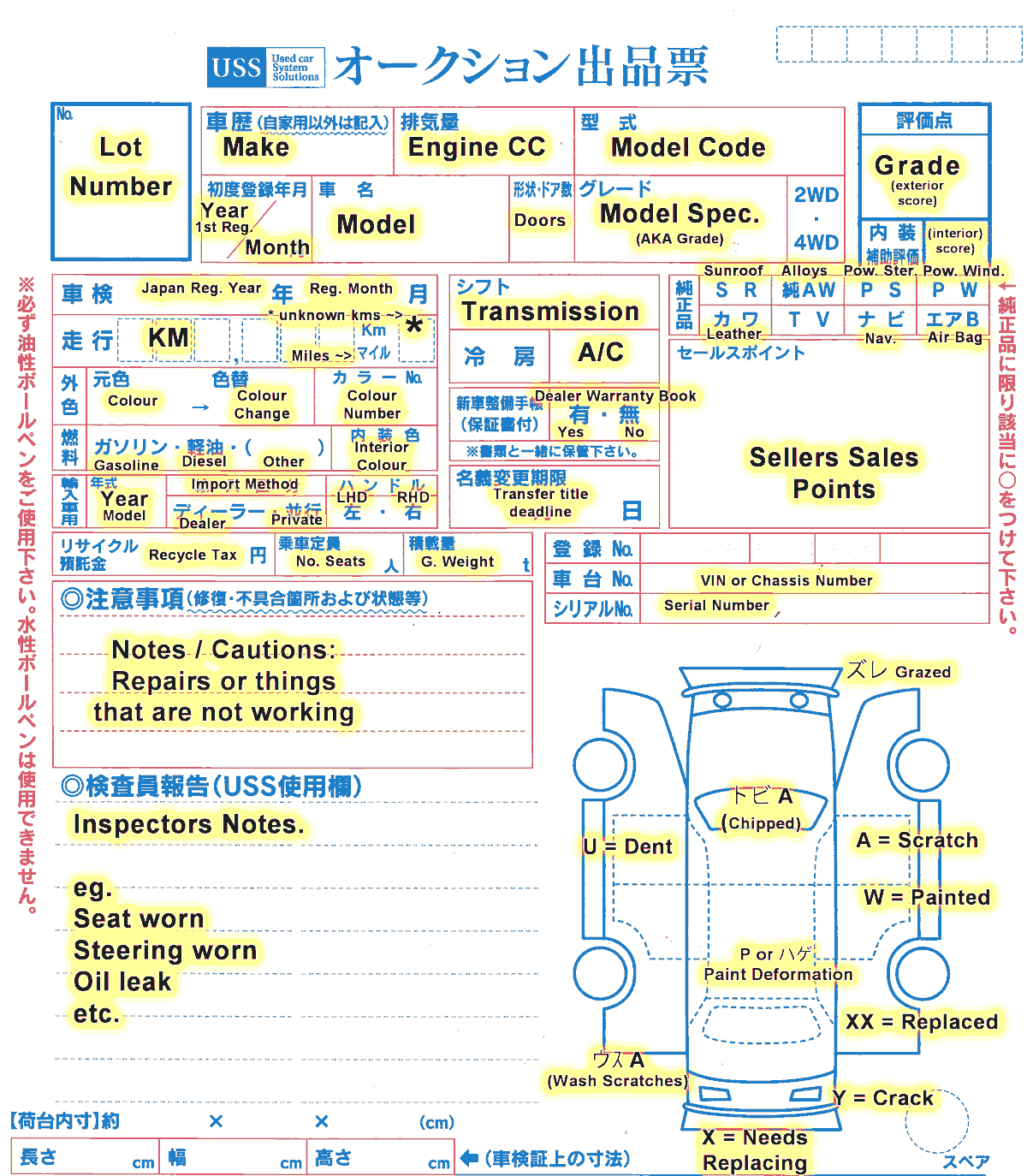
Every car at auction comes with an auction sheet — the inspector's report of the car's condition. The example below shows a typical USS auction sheet with each area explained in English. The inspector marks damage on the car diagram using short codes and Japanese shorthand, which are explained in the tables that follow. Our team translates the full sheet for you on any car you are interested in.
Body Diagram Codes
The car diagram on the auction sheet is marked with letter codes showing the location, type and size of any damage. Scratches (A) and dents (U) are the most common marks you will see.
| Code | Meaning |
|---|---|
| Scratches | |
| A / A1 | Scratch up to hand size |
| A2 | Scratch one to two hand size |
| A3 / A4 | Scratch over two hand size |
| Dents | |
| U1 | Small dent, up to the size of the base of a thumb |
| U2 | Dent up to hand size |
| U3 | Dent larger than a hand size |
| E | Very small dents and dimples |
| Scratch + Dent | |
| B1 / B2 / B3 | Scratch and dent (up to thumb size / up to hand size / larger than a hand) |
| AU1 / AU2 / AU3 | Combined scratch and dent, small / medium / large — many auctions (including USS) use AU as a single merged code instead of B |
| Cracks & Glass | |
| Y1 / Y2 / Y3 | Cracks or splits (up to thumb size / up to hand size / larger than a hand) |
| G / G1 | Windshield glass chip or crack (G1 = small stone chip) |
| Paint & Repair | |
| W / W1 | Repaint of high quality |
| W2 | Repaint slightly wavy but good repair condition |
| W3 | Repaint of lower quality |
| Inspectors also use W to note panel waves or distortion left by previous repair work. | |
| BP | Panel repaired and repainted — short for Body & Paint (板金塗装) |
| P (Pハゲ / Pアセ / Pシミ) | Paint faded / slightly discoloured / stained or oxidised |
| Replacement | |
| XX | Panel replaced |
| X | Part needs replacing |
| When XX is marked on core supports, floor panels or pillars, it indicates a structural replacement or a cut-and-joined section. | |
| Rust & Corrosion | |
| S / S1 | Surface rust on the body |
| S2 / S3 | Medium to heavy rust (spreading, or threatening structural integrity) |
| C1 / C2 | Corrosion bubbles or flaking coming through the panels / heavy corrosion |
Codes written under the chassis outline refer to the underbody — A there means underbody scrapes, and U means chassis or frame dents (frame rails, floor pans, jack points).
Common Diagram Katakana Annotations
Inspectors often add handwritten Japanese shorthand next to the codes. These are the most common terms you will see on the diagram.
| Japanese | Reading | Meaning |
|---|---|---|
| トビ / トビ石 | Tobi / Tobi-ishi | Stone chip(s) — frequently combined with sizes (e.g. トビA for small stone chips) or written on windshields and front ends. On a windscreen, トビ is usually a tiny, repairable stone chip — almost every used car has one or two of these |
| ヒビ | Hibi | Crack or hairline fracture — commonly on glass, plastic bumpers, light lenses or dashboard trim. On a windscreen, ヒビ is a step up from トビ: a small chip or crack that has started to spread, which may need repair or glass replacement |
| スレ / スリ | Sure / Suri | Scrape, scuff or friction wear (often combined as スリA or スレA) — often the type of scrape found under the front bumper lip |
| ズレ | Zure | Misaligned, shifted or displaced — commonly used for bumpers, body kits, side skirts or panel gaps |
| ウス | Usu | Light, faint or shallow — used as a modifier (e.g. ウスキズ = shallow scratches, ウスヘコミ = faint dimples) |
| ワレ | Ware | Broken, split or heavy crack — commonly marked on spoilers, side skirts, bumpers and body kits |
| ハゲ / Pハゲ | Hage / P-Hage | Peeling or flaking — usually paint peeling or clear-coat failure |
| サビ | Sabi | Surface rust |
| ヘコミ / 凹 | Hekomi | Dent (written out instead of, or alongside, U) |
| キズ | Kizu | Scratch (written out instead of, or alongside, A) |
| アセ / 色アセ | Ase / Iro-ase | Paint fading or discoloration — frequently noted on carbon hoods/wings, roofs or trunks |
| ムラ | Mura | Unevenness / wavy paint — often seen with repainted panels (ペイントムラ) |
| シワ | Shiwa | Wrinkled, creased or wavy — used for leather seat wear or subtle sheet-metal creasing |
| コゲ / コゲ穴 | Koge / Koge-ana | Cigarette burn / cigarette burn hole (interior seat or headliner) |
| ヨゴレ | Yogore | Dirt, stain or soil (interior upholstery or headliner) |
| ヤブレ | Yabure | Tear or rip (seats, door trims or steering-wheel wrap) |
| タレ | Tare | Sagging (headliner) or a paint run/drip |
| コウカン | Koukan | Replaced / needs replacement |
| カバー | Kabaa | Cover (e.g. bumper cover, mirror cover) |
Key Modifier Prefixes & Suffixes
| Japanese | Reading | Meaning |
|---|---|---|
| 小 | Sho / Ko | Small / minor (e.g. 小キズ = minor scratch, 小凹 = minor dent) |
| 大 | Dai | Large / major (e.g. 大キズ = deep or large scratch) |
| 多 | Ta | Many / multiple (e.g. キズ多 = multiple scratches) |
| 不調 / 不良 | Fuchou / Furyou | Defective, faulty or malfunctioning (e.g. AC不良 = air-conditioning faulty) |
| 人 | Nin | A person — used to indicate the number of seats (e.g. 5人 = 5 seats) |
Criteria for R Grade
In order to be an R grade, the structural parts below need to have been replaced or repaired. However, this does not apply to any structural components that could be attached by bolts or screws, it therefore only covers the "skeleton" that is welded together. The diagrams below show where these structural parts are on the car.
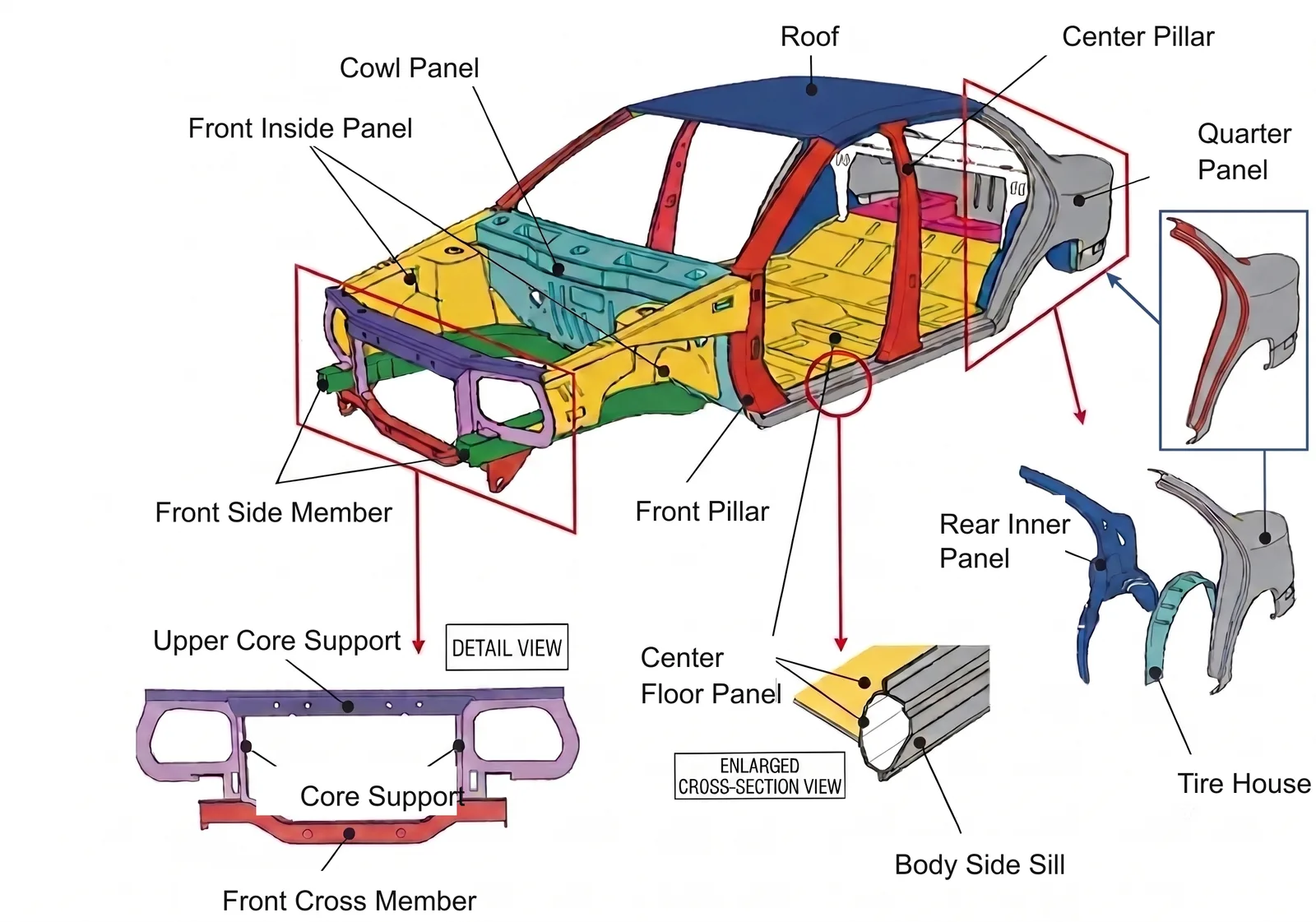
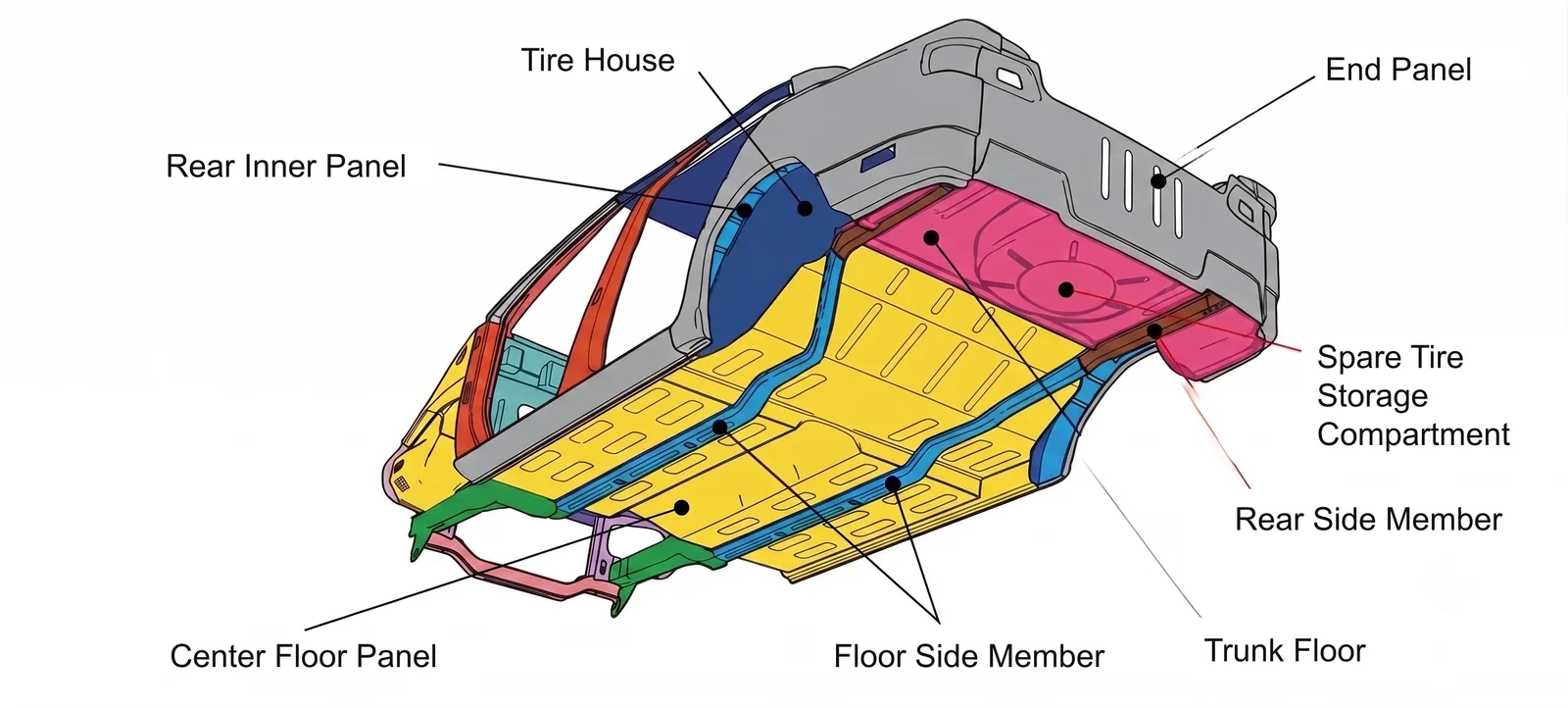
The structural diagrams and repair-history criteria on this page are based on training materials from AIS (Automobile Inspection System), Japan's leading vehicle-inspection standards organisation. Our inspection staff have attended AIS training workshops and hold AIS certification.
| No | Structure | Criteria |
|---|---|---|
| 1 | Cross member (front and rear) | Replaced; or has a bend, dent or repair traces |
| 2 | Side members (front and rear) — front: only the section behind the core support | Replaced; or has a bend, dent or repair traces |
| 3 | Inside Panel (front) / Dash panel (firewall) — front: only the section behind the core support | Replaced; or dents or repair traces that have spread from the outside or through the outer panel |
| 4 | Pillar (front, centre, rear) | Replaced, re-spot welded, dents or repair traces that have spread through the panel |
| 5 | Roof | Replaced, a dent or repair traces spreading from a pillar or on the inside part of the roof |
| 6 | Centre floor panel / Floor side member | Replaced parts, joints separating, cracks, bends or repair traces |
| 7 | Rear floor panel / Trunk floor | Replaced parts, joints separating, cracks, bends or repair traces |
| 8* | Radiator core support | Replaced, and with damage to the adjacent inside panel (dents), cross member or side member (bends or dents), or their repair traces |
* From April 1, 2016 the radiator core support is excluded from the above table.